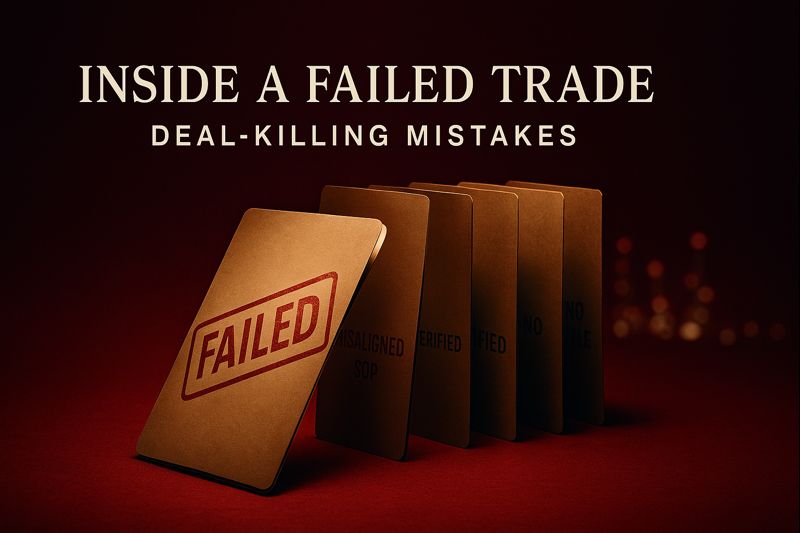
Inside a Failed Trade: The Most Common Deal-Killing Mistakes
Explore the most common factors behind failed fuel transactions: conflicting SOPs, red flag behaviour, communication breakdowns, and procedural misalignment. Learn how structured operators avoid these pitfalls.
12/24/20252 min read
Introduction
Most fuel transactions do not fail at the refinery.
They fail long before that — at the procedural, operational, and behavioural level.
Having verified thousands of documents and deal flows, Stratos Advisory observes the same repeated patterns.
Regardless of region, product, or counterparty size, trades collapse for predictable reasons.
This article dissects the structural mistakes behind failed deals, drawn from anonymised real-world cases.
1. Procedural Mismatch: The Silent Deal Killer
The most consistent source of failure is incompatible SOPs.
Examples include:
Buyers demanding procedures sellers do not support
Sellers insisting on outdated, non-compliant sequences
Brokers modifying terms without authority
Mandates mixing procedures from unrelated markets
Incorrect assumptions about POP timelines
Procedures are not suggestions — they are structural frameworks.
When either party uses the wrong one, the deal cannot progress.
2. Lack of Verification: When Hope Replaces Evidence
Deals often fall apart because participants attempt execution before verification.
Repeated patterns include:
🚩 Unverified SGS documents
Dates, vessel names, or quality specs inconsistent with reality.
🚩 Fabricated POP chains
Documents sequenced incorrectly, missing compliance markers.
🚩 Inability to prove product at discharge
Verbal claims replacing physical evidence.
🚩 Falsified refinery ties
Refinery names used without legal authority or corporate linkage.
Verification is not optional; it is a prerequisite to negotiation.
3. Communication Breakdown: Professional vs. Non-Professional Behavior
Professionals communicate with clarity.
Non-professionals communicate with emotion.
Patterns we see in failed deals include:
🚩 Emotional escalation when asked for documents
A strong indication the deal lacks structure.
🚩 Nationalistic or personal attacks
Always a marker of non-performance.
🚩 Overuse of authority claims
“Government connections,” “exclusive control,” “refinery family,” etc.
🚩 Evasion under procedural questions
The inability to explain SOPs is a high-confidence red flag.
Communication style is not a personality issue — it is an accuracy indicator.
4. Misaligned Expectations: When Both Parties Think They Are in Control
Many deals collapse because parties enter with incompatible assumptions:
Buyers assume full transparency.
Sellers assume strict procedure adherence.
Brokers assume discretionary negotiation rights.
Mandates assume authority they don’t have.
Without alignment, every step creates friction.
5. Multilayered Intermediary Chains
The longer the chain, the higher the failure rate.
Intermediaries often:
Edit documents
Alter procedures
Add unnecessary conditions
Miscommunicate requirements
Hide counterparties
Inflate credibility
Chains dilute accuracy.
Without structural discipline, they introduce risk rather than value.
Conclusion
Failed trades are rarely the result of bad product.
They are the result of bad structure.
Most collapses occur because parties:
Don’t verify
Don’t align procedures
Don’t communicate professionally
Don’t screen counterparties
Don’t understand compliance
Don’t maintain structural discipline
Professionalism isn’t measured by how loudly someone speaks.
It is measured by how well they align with reality.
For verification, structural advisory, or counterparty screening:
📩 info@stratosoil.com.my
CONTACT
Get in touch with our team.
Follow
JOIN OUR EXCLUSIVE NEWSLETTER
info@stratosoil.com.my
+60 149234360
© 2025 - 2026 Stratos Trading | Stratos Advisory. All rights reserved.
Empowering global trade with verification, integrity, and precision.
“The world doesn’t run on oil alone — it runs on trust.”