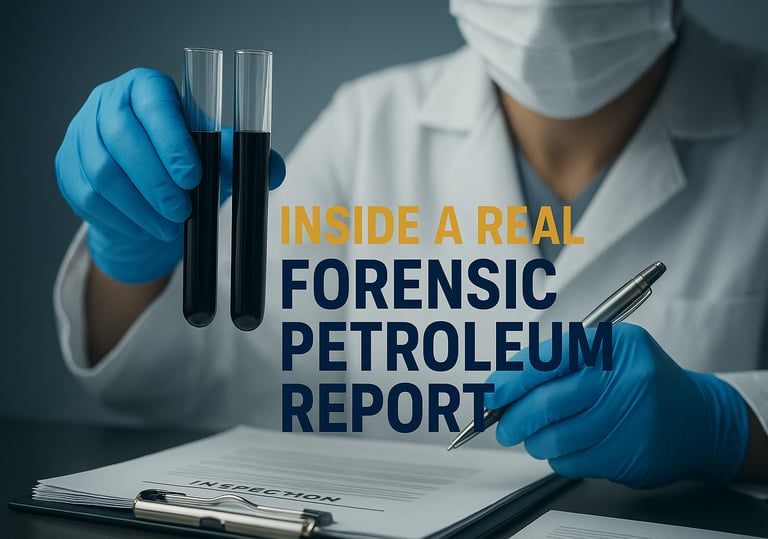
Inside a Real Forensic Petroleum Report — What Verification Actually Looks Like
What separates professional verification from routine due diligence? Stratos Trading opens the curtain on how forensic petroleum reporting truly works — without revealing trade secrets — and explains why every serious player in oil & gas needs this level of scrutiny before committing capital.
Stratos Trading
10/19/20252 min read
⚙️ Introduction
In petroleum trading, documentation is the backbone of every transaction. Yet, behind each certificate, tank receipt, or inspection report lies a simple question: is any of this actually true?
That’s where forensic petroleum analysis comes in — the science and discipline of proving that a document reflects physical reality.
At Stratos Trading, our verification work begins where ordinary due diligence ends.
🧾 From Paper to Proof
Traditional document checks confirm what a paper says.
Forensic verification proves what a paper means.
A true petroleum report links measurable data — density, quantity, sampling timelines, inspection identifiers — to physical custody evidence.
Our analysts don’t just look for signatures; we test consistency across:
Technical parameters – densities, sulphur levels, flash points
Measurement data – tank volumes vs SGS outturns
Chronology – whether sampling and injection timelines align
Custody chain – evidence of seals, courier logs, calibration tables
When those elements line up, authenticity speaks for itself. When they don’t, risk turns red.
🔍 The Difference Between Review and Forensics
Many firms perform a “document review.” It’s a checklist.
Forensics is an audit — a reconstruction of reality.
Our reports trace the journey of the product: where it was measured, how it was stored, when it moved, and who handled it.
We integrate cross-verification with inspection agencies, terminal records, and industry databases to validate each claim.
The result is a report that not only flags inconsistencies but also provides actionable clarity — enabling decision-makers to proceed with confidence or pause before disaster.
🧠 What You Won’t See (And Why)
You won’t find our exact formulas or forensic software publicly listed.
That’s intentional.
Because the methods that detect high-level fraud are precisely what fraudsters study next.
Our clients don’t pay for curiosity — they pay for protection.
We share conclusions, not code. Findings, not full frameworks.
It’s how we maintain integrity in a market where transparency must coexist with discretion.
💡 Why It Matters
A genuine forensic report transforms speculation into evidence.
For corporations and institutions, that means:
Capital Protection – funds aren’t lost chasing fabricated supply
Compliance Confidence – documentation stands under audit
Reputation Security – partners trust verified data
Operational Clarity – decisions are grounded in fact, not forwarded files
In an industry where perception often replaces proof, forensics restores balance.
💬 Conclusion
A real forensic petroleum report is not just paperwork — it’s a safeguard.
It separates what’s claimed from what’s confirmed.
Before signing, shipping, or sending payment, insist on professional verification.
Because assumptions may be free — but mistakes never are.
📩 Work with the Experts
At Stratos Trading, we provide confidential forensic verification, document authenticity analysis, and fraud-prevention consulting for global petroleum transactions.
💬 Send an email to info@stratosoil.com.my to request a sample forensic report or schedule a consultation.
Verification isn’t a step — it’s a strategy.
CONTACT
Get in touch with our team.
Follow
JOIN OUR EXCLUSIVE NEWSLETTER
info@stratosoil.com.my
+60 149234360
© 2025 - 2026 Stratos Trading | Stratos Advisory. All rights reserved.
Empowering global trade with verification, integrity, and precision.
“The world doesn’t run on oil alone — it runs on trust.”