When ‘Allocated’ Means Nothing — The Misuse of Petroleum Allocations
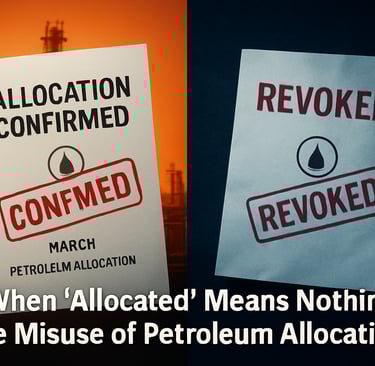
The term “allocated” is thrown around in oil and gas trading far too loosely. Stratos Trading breaks down how fake or misrepresented allocations distort the market, how to identify red flags, and why true allocation rights are always verifiable through forensic due diligence.
Stratos Trading
11/9/20252 min read
⚙️ Introduction
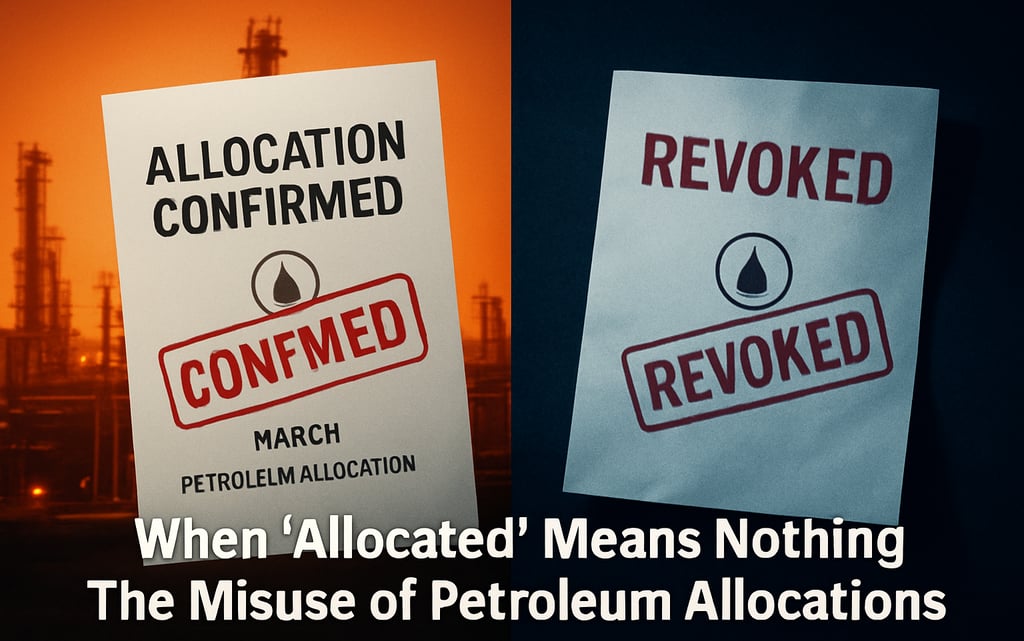
Few words create more false confidence in petroleum trading than “allocated.”
Every broker has seen it: “Seller holds allocation direct from refinery.”
But here’s the truth — most of those “allocations” don’t exist in any legal, physical, or operational sense. They’re copied, fabricated, or expired.
And believing them can cost millions.
At Stratos Trading, we’ve reviewed hundreds of allocation documents that look official — refinery letterheads, reference codes, and all — but crumble under forensic scrutiny.
🧾 What an Allocation Actually Is
A genuine petroleum allocation is a right of entitlement issued by a refinery, terminal, or authorized seller to a verified entity.
It grants access to a specific product volume under defined contractual terms.
Real allocations come with:
Reference and registration numbers traceable to the issuing authority.
Contractual linkage to storage, shipping, or lifting schedules.
Verification through terminal and inspection agencies.
Signed authorization by officials with verifiable corporate identities.
In short, a legitimate allocation can be proven — not just claimed.
🚩 The Rise of “PDF Allocations”
Fraudulent allocations circulate faster than legitimate ones because they’re easy to produce and impossible to validate without deep industry access.
Here’s what we frequently uncover:
Expired documents reused from previous deals.
Forged refinery letters created from stolen templates.
Misappropriated allocation codes lifted from real transactions.
Digital fakes where metadata shows recent editing by unknown users.
These documents look convincing until you inspect the fine details — that’s where most fraud hides.
🧠 Why “Allocated” Doesn’t Mean “Available”
Even when an allocation is real, it may not be active or transferable.
Allocations are often non-transferable entitlements, meaning only the named holder has lifting rights. When intermediaries try to “flip” allocations, they violate the very terms that make them valid.
This confusion creates entire chains of brokers trading rights that don’t exist — a process that fuels mistrust and drains liquidity from legitimate markets.
🕵️♂️ The Stratos Verification Process
When Stratos Trading conducts allocation verification, our team:
Confirms the allocation’s authenticity with the issuing authority or terminal.
Cross-references allocation numbers and storage data.
Validates legal ownership and transfer rights.
Analyzes document metadata and audit trails.
Our objective isn’t just to check a PDF — it’s to ensure the document represents a real, live entitlement under enforceable conditions.
💡 Why Professional Verification Is Critical
An “allocation letter” may look harmless — until it’s used as proof of supply in a major deal.
One fake entitlement can lead to blocked LCs, lost deposits, and legal disputes that take months to resolve.
In today’s environment, verification isn’t optional — it’s a compliance requirement.
And it’s the only way to separate opportunity from illusion.
💬 Conclusion
If your deal depends on an allocation, make sure it’s real — and make sure it’s yours.
Because once the word “allocated” is misused, everything built on it collapses.
📩 Consult Stratos Trading
At Stratos Trading, we provide forensic verification of allocations, inspection certificates, and trade documentation for global petroleum transactions.
💬 Send an email to info@stratosoil.com.my to request a sample verification report or schedule a consultation.
Because in this industry, “allocated” only matters when it’s authentic.
CONTACT
Get in touch with our team.
Follow
JOIN OUR EXCLUSIVE NEWSLETTER
info@stratosoil.com.my
+60 149234360
© 2025 - 2026 Stratos Trading | Stratos Advisory. All rights reserved.
Empowering global trade with verification, integrity, and precision.
“The world doesn’t run on oil alone — it runs on trust.”