Why Counterparty Screening Is Non-Negotiable in Global Fuel Trade
Counterparty screening in oil and gas is not a formality — it is a critical risk-control function. Learn why AML, compliance, geopolitical exposure, and bank behaviour make screening essential for safe and successful fuel transactions.
12/17/20252 min read
Introduction
In the oil and gas trading ecosystem, most losses do not occur because of market volatility — they occur because of counterparties.
A single unverified seller, a fabricated mandate, or an untested intermediary can expose a trader or institution to financial loss, compliance breaches, and reputational damage.
Stratos Advisory’s internal verification data shows that more than 70% of opportunities submitted to us collapse before commercial negotiations even begin — not because the deal is bad, but because the counterparty is.
This is why screening is not optional.
1. AML & Compliance: The First Layer of Protection
Anti-money laundering (AML) requirements exist for a reason. The global commodities market is structurally high-risk:
Multi-jurisdictional actors
Opaque company structures
High-value transactions
Intermediary-heavy deal chains
Counterparties must be screened for:
• Beneficial ownership clarity
• Sanctions exposure
• Corporate registration authenticity
• Litigation history
• Past fraud patterns
• Geopolitical restrictions
Failure in any of these areas can result in immediate institutional disengagement.
One weak counterparty does not simply kill the deal — it puts your business at risk.
2. Geopolitical Exposure: When Origin Determines Risk
Fuel trade is deeply linked to geopolitics.
Banks, insurers, traders, and ports all react to:
Country-of-origin restrictions
Sanctions on producers, refiners, and shipowners
Political instability affecting supply chains
Legislation that restricts product movement across certain regions
A counterparty tied to a sensitive region can create compliance bottlenecks even if the product is real.
Screening identifies geopolitical red flags before you become entangled in them.
3. Bank Behaviour: The Silent Gatekeeper
Banks are the invisible but decisive stakeholders in every fuel transaction.
They evaluate:
Counterparty legitimacy
Transaction history
Source of funds
Jurisdictional risk
Compliance alignment
When any counterparty in the chain is questionable, banks may:
Decline payments
Freeze funds
Demand enhanced due diligence
Flag the transaction as high-risk
Delay or reject LC issuance
Banks don’t negotiate with “stories.”
They negotiate with verified entities.
4. Operational Credibility: The Filter Between Real and Fiction
In our work, the most common operational failures include:
🚩 Fictitious refiners
Companies claiming refinery ties with no corporate linkage.
🚩 Mandates with unverifiable authority
No contract, no legal appointment, no traceability.
🚩 Shell companies used as sellers
Non-operational entities claiming full allocation control.
🚩 Inconsistent documentation
Fabricated COAs, mismatched SGS dates, conflicting vessel timelines.
🚩 Gmail or generic email domains
Always a structural red flag at Stratos.
These are not small issues.
They are indicators of systemic risk.
5. Screening Is Not About Distrust — It’s About Structure
Professional operators understand that screening:
Saves time
Reduces exposure
Protects capital
Filters noise
Removes non-performing chains
Ensures counterparties can withstand scrutiny
If a counterparty collapses during screening, they would have collapsed during the transaction — except with far greater consequences.
Conclusion
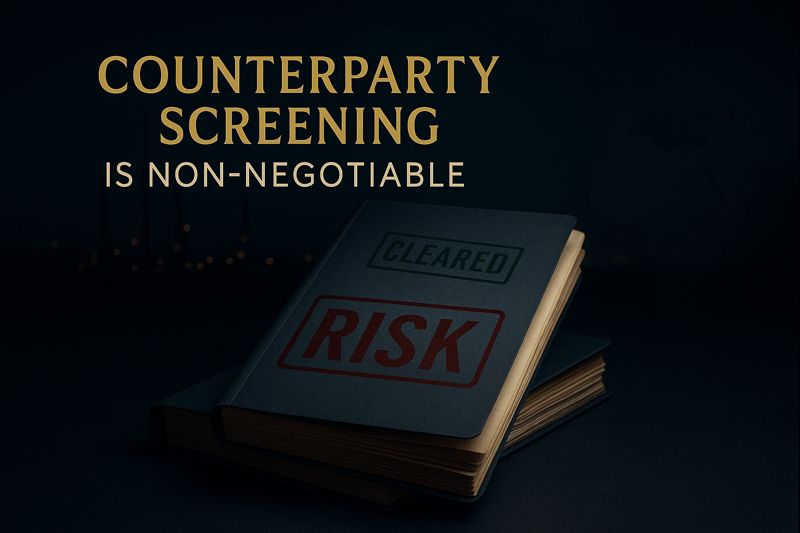
Counterparty screening isn’t a defensive posture.
It’s an operational requirement.
In a sector where counterparties determine the entire trajectory of a deal, screening is not an inconvenience — it is the first proof of professionalism.
If you want structural integrity in your deal flow, screening must come before negotiation.
For verification, counterparty analysis, or compliance advisory:
📩 info@stratosoil.com.my
CONTACT
Get in touch with our team.
Follow
JOIN OUR EXCLUSIVE NEWSLETTER
info@stratosoil.com.my
+60 149234360
© 2025 - 2026 Stratos Trading | Stratos Advisory. All rights reserved.
Empowering global trade with verification, integrity, and precision.
“The world doesn’t run on oil alone — it runs on trust.”